
self-education university: learning to draw without art school
how i taught myself to draw: 4 lessons that made the biggest difference

Hello!
One of the things I love most about drawing is that it is a skill you can genuinely teach yourself.
Of course, talent can help, but in my experience, drawing is far more about observation, practice, and patience than natural ability. I’ve seen my own work improve over the years, and I’ve watched countless other artists transform their skills simply because they kept showing up and practicing.
Along the way, I’ve discovered a few principles that made a significant difference in my progress. If you’re learning to draw, these are the lessons I wish someone had told me earlier.
With that in mind, I’d like to share exercises that have helped me train my eye, improve my observation skills, and better understand how artists see the world around them. Drawing is often taught as a matter of technique, but in my experience, learning to draw begins long before the pencil touches the paper. It begins with learning to observe. Learning to notice details. Learning to recognize light and shadow. Learning to simplify complexity into shapes and forms. The exercises below are designed to help you develop those skills.
As a paid subscriber, you’ll find the complete collection of exercises, including activities that train you to observe everyday objects more carefully, studies that help you break complex subjects down into simple shapes, exercises focused on light and shadow, and drawing challenges designed to strengthen your visual memory and understanding of form. These are practical exercises you can work through step by step to develop the fundamental skills behind confident drawing.
These are the same types of exercises I still return to today whenever I want to sharpen my eye, strengthen my artistic foundation, and continue growing as an artist. Because drawing is not only about learning how to move your hand. It’s about learning how to see.
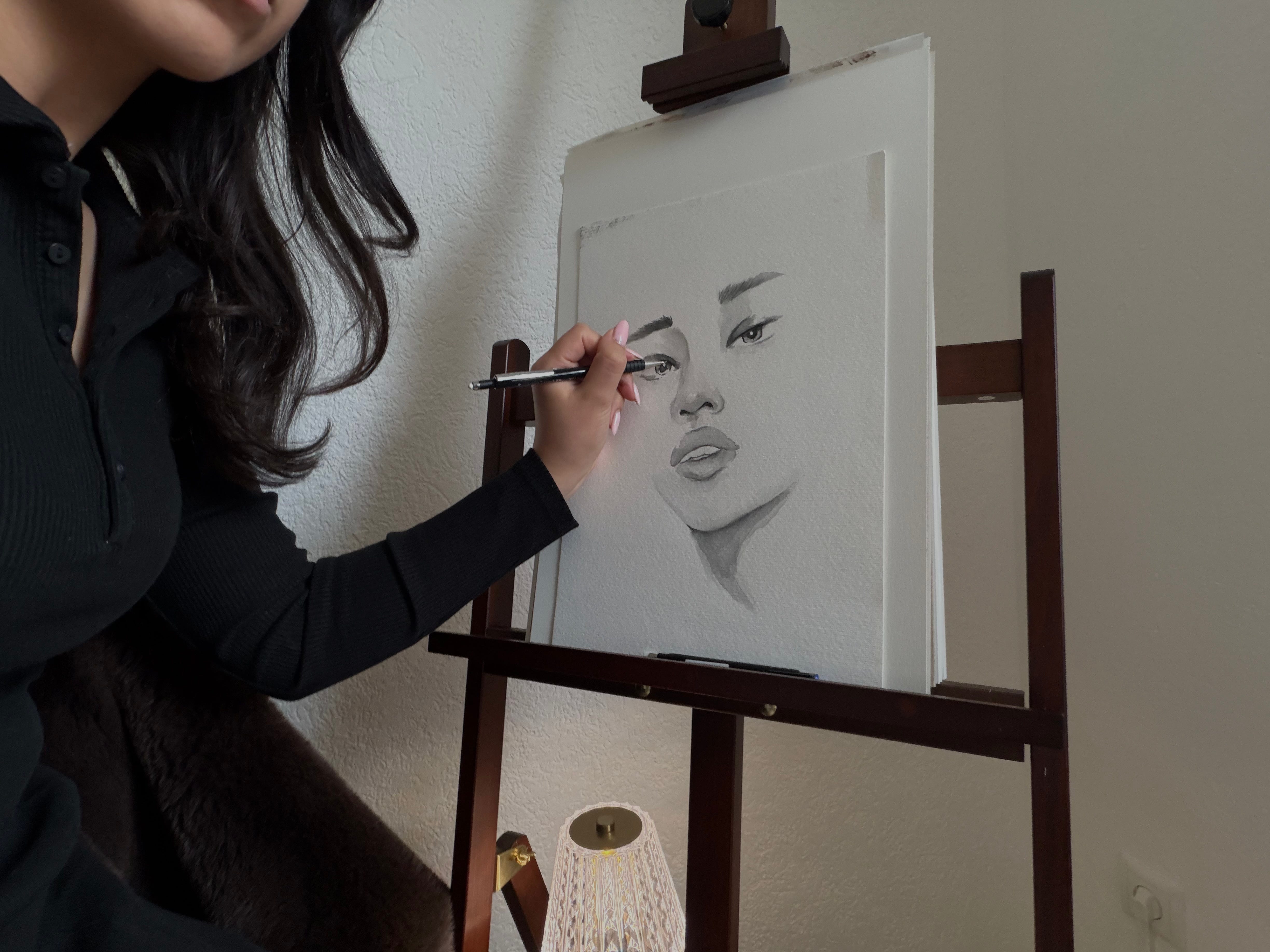
1. Great Artists Are Great Observers
This is probably the most important lesson I’ve learned. A good artist is, first and foremost, a good observer. The better you become at observing, the better your art becomes. This applies to creativity in general, but especially to drawing. When people look at a face, they often see a face. When artists look at a face, they notice details.
Before you even put your pencil on paper, spend time studying what you’re about to draw.
If you’re drawing a portrait, look closely at the eyes. Notice the shape of the nose. Observe where the light hits and where the shadows fall. Pay attention to the proportions, the eyelashes, the lips, the subtle curves of the ears, the texture of the skin, and the relationship between each feature.
The same applies to drawing flowers, buildings, animals, or objects. Train yourself to truly see before you draw. Many beginners rush straight into sketching, but observation is often where the drawing actually begins.
2. Learn to See Light and Shadow
For a long time, I focused mainly on outlines and shapes. Later, I realized that light and shadow are what truly bring a drawing to life.
In fact, you could create an entire image by focusing only on values, the different levels of lightness and darkness, without worrying too much about details at first.
Everything we see is shaped by light. Light creates highlights. Shadows create depth. Together, they create form. The more you train your eye to recognize where light is coming from and how it affects an object, the more realistic your drawings will become. Start simple.
Notice where the darkest shadows are. Look for the lighter shadows. Observe the transition between light and dark. Learning to see these subtle differences can dramatically improve your artwork.
3. Break Everything Down Into Simple Shapes
One of the easiest ways to make drawing less overwhelming is to stop seeing objects as complicated things. Instead, see them as collections of simple shapes.
A face can begin with circles and guidelines. A flower can be broken down into basic geometric forms. A building can be simplified into rectangles and triangles.
Personally, I like starting with very light circles and rough sketches. These simple shapes help me understand proportions and placement before I commit to details.
Think of them as a framework. Once the structure is in place, it’s much easier to refine and develop the drawing.
Many beginners jump directly into details and then wonder why something feels off. Often, the issue isn’t the detail itself, it’s the underlying structure.
4. Don’t Compare Yourself to Other Artists
This is less about technique and more about mindset. If you’re a beginner, please don’t discourage yourself by comparing your work to artists who have been practicing for years. Instead, study the art you admire. And honestly? Copy it. Not to publish it. Not to claim it as your own. Copy it to learn.
This might sound controversial coming from an artist, but copying is one of the oldest learning methods in art. Many great artists, writers, and creatives have openly talked about studying and imitating the work they loved when they were starting out. When you copy a piece, you’re training your eye. You’re learning proportions, composition, techniques, and decision-making.
Over time, something interesting happens. You start changing little things. You add your own preferences. You develop habits and techniques that feel natural to you. Gradually, your own style begins to emerge. Your style is rarely created overnight. More often, it develops from years of learning, experimenting, and borrowing inspiration from others.
Final Thoughts
If I could summarize everything in one sentence, it would be this: Observe more than you draw. The better you become at seeing, the better you become at creating. Drawing isn’t about perfection. It’s about training your eyes, your hands, and your patience. Keep practicing. Keep observing. Keep experimenting. You will improve far more than you think.
3 Simple Drawing Exercises to Train Your Eye
Here are three simple exercises that can help you strengthen your observation skills, understand light and shadow, and simplify complex scenes into basic shapes.

Here’s the photograph we’ll be working with today.
We’ll use this single image for all three exercises, training our observation skills, studying light and shadow, and learning to identify the simple shapes hidden within a complex scene.